


You’re at the cheese shop in Rome, eyeing a wedge of aged Parmigiano. Or you’ve just picked up a vacuum-sealed pack of biltong in South Africa, a bag of dried sausage from the Philippines, or your grandmother’s homemade beef jerky before heading back to the US. One question stops you at the register: what meat and cheese can you bring into the US, and what stays behind?
Meat, dairy, and cured products rank among the most confusing food categories at US Customs — and the most commonly confiscated. The rules aren’t arbitrary; they exist to protect American livestock from devastating diseases. But they’re more nuanced than most travelers realize. Some things you’d expect to sail through don’t. Some things you’d assume get confiscated actually clear just fine.
Here’s the full breakdown.
The Rule That Never Changes: Declare Everything
Before we get into specifics, the same rule from our food customs guide applies here: declare every meat, dairy, and animal product you’re carrying, without exception. If you declare something that turns out to be prohibited, it gets confiscated, and you walk away with no fine. If you don’t declare it and it’s found (by a detection dog, an X-ray, or a manual inspection), the fine starts at $300 and goes up to $10,000 for repeat violations.
Why Are Meat Rules So Strict?
Foot-and-mouth disease, bovine spongiform encephalopathy (mad cow disease), African swine fever, and avian flu can all be carried on or in meat products. These diseases don’t affect humans directly, but an outbreak in US livestock can cause billions in economic damage and devastate farming communities. A single contaminated item in someone’s luggage is all it takes to introduce a disease that doesn’t currently exist in the US.
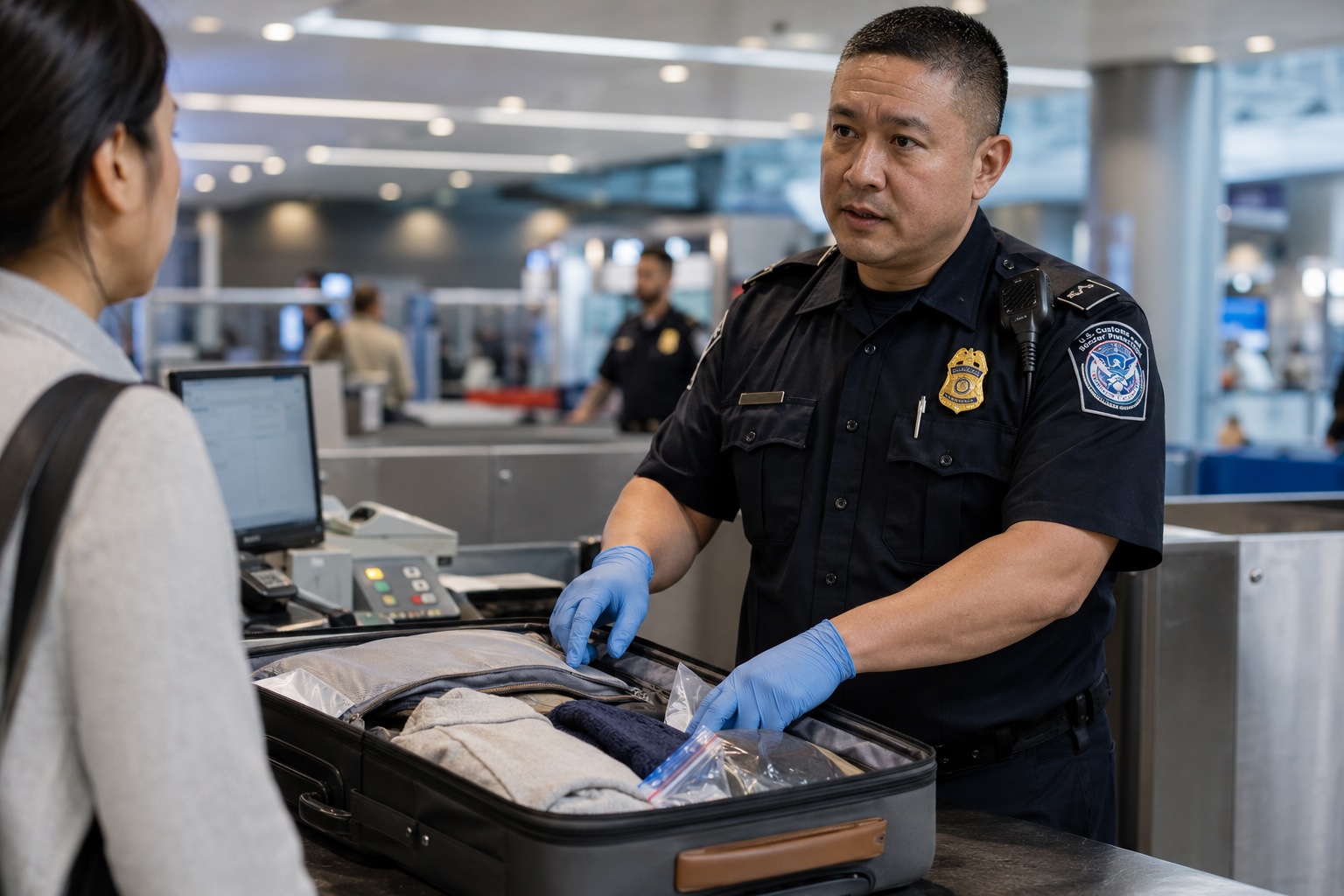
Fresh, Dried, and Cured Meats: The General Rule
The starting point for understanding what meat and cheese you can bring into the US is this: almost all meat from foreign countries starts in the prohibited column. That’s not the end of the story, but it’s where you begin. The country your meat comes from matters as much as what kind of meat it is: disease status changes frequently, and a country that qualified last year may not qualify today.
The USDA prohibits travelers from bringing back most cattle, swine, sheep, and goat meat or meat products from countries affected with serious livestock diseases. Because disease status changes frequently (outbreaks occur, and countries gain or lose disease-free status), the rules for any given country can shift with little notice. The country your meat comes from matters as much as what kind of meat it is.
Here’s how it breaks down by category:
Fresh, Chilled, or Frozen Meat
Fresh meat from most countries is prohibited. If it comes from a country the USDA considers free of the relevant livestock diseases and you have documentation of its country of origin, it may be allowed. That documentation can be the original package label, a receipt, your proof of travel, or a certificate of origin. Without documentation, don’t count on it clearing.
Cooked Meat (Commercially Packaged)
This is the pathway most travelers can realistically use. Commercially packaged, labeled, shelf-stable cooked meat in unopened hermetically sealed containers (canned corned beef, canned luncheon meat, etc.) is generally allowed from most countries, as long as it’s declared and inspected. The key requirements are: commercially produced, fully cooked, shelf-stable (no refrigeration needed), sealed, and labeled with the country of origin and ingredients.
Homemade or Unwrapped Cooked Meat
Not allowed. A CBP officer cannot verify the ingredients, origin, or preparation standards of homemade cooked meat. The grandmother’s stewed chicken in a container, the homemade sausage wrapped in foil: these will be confiscated regardless of how they were made. Declare them, let the inspector confirm the decision, and move on.
Pork Products
When it comes to pork, you cannot bring it back from most countries due to the risks of African Swine Fever and classical swine fever. Pork products from Mexico are banned, although a small amount of thoroughly cooked pork for personal consumption (like a ham sandwich) may be allowed at land borders at an inspector’s discretion. Don’t rely on that. If you’re carrying pork products, declare them and expect they may not make it through.
Beef Jerky: The Question Everyone Asks
Beef jerky is one of the first things travelers ask about when figuring out what meat they can bring into the US, and the answer is more complicated than most people expect.
Homemade beef jerky: not allowed. Full stop. There is no exception. The USDA prohibits homemade dried meat from entering the US regardless of how it was made, who made it, or where the beef came from. If your family made it, it stays behind or gets confiscated at the border.
Commercially packaged beef jerky: possible, but not guaranteed. Commercial jerky from countries considered free of relevant livestock diseases — including Canada, Australia, New Zealand, and Argentina — may be allowed if it is properly packaged, labeled with the country of origin, and declared. Even then, approval is at the inspector’s discretion and not guaranteed. The jerky must be commercially produced, labeled, and in unopened packaging.
Beef jerky from most of Africa, Asia, and countries with active livestock disease status is prohibited regardless of commercial packaging. The country of origin is the determining factor, not just the packaging.
The 50-pound Rule
Any meat product over 50 pounds is classified as a commercial shipment and requires additional permits and inspections beyond what a traveler can arrange. For personal travel, keep quantities under 50 pounds. Practically speaking, you’re unlikely to carry that much anyway.
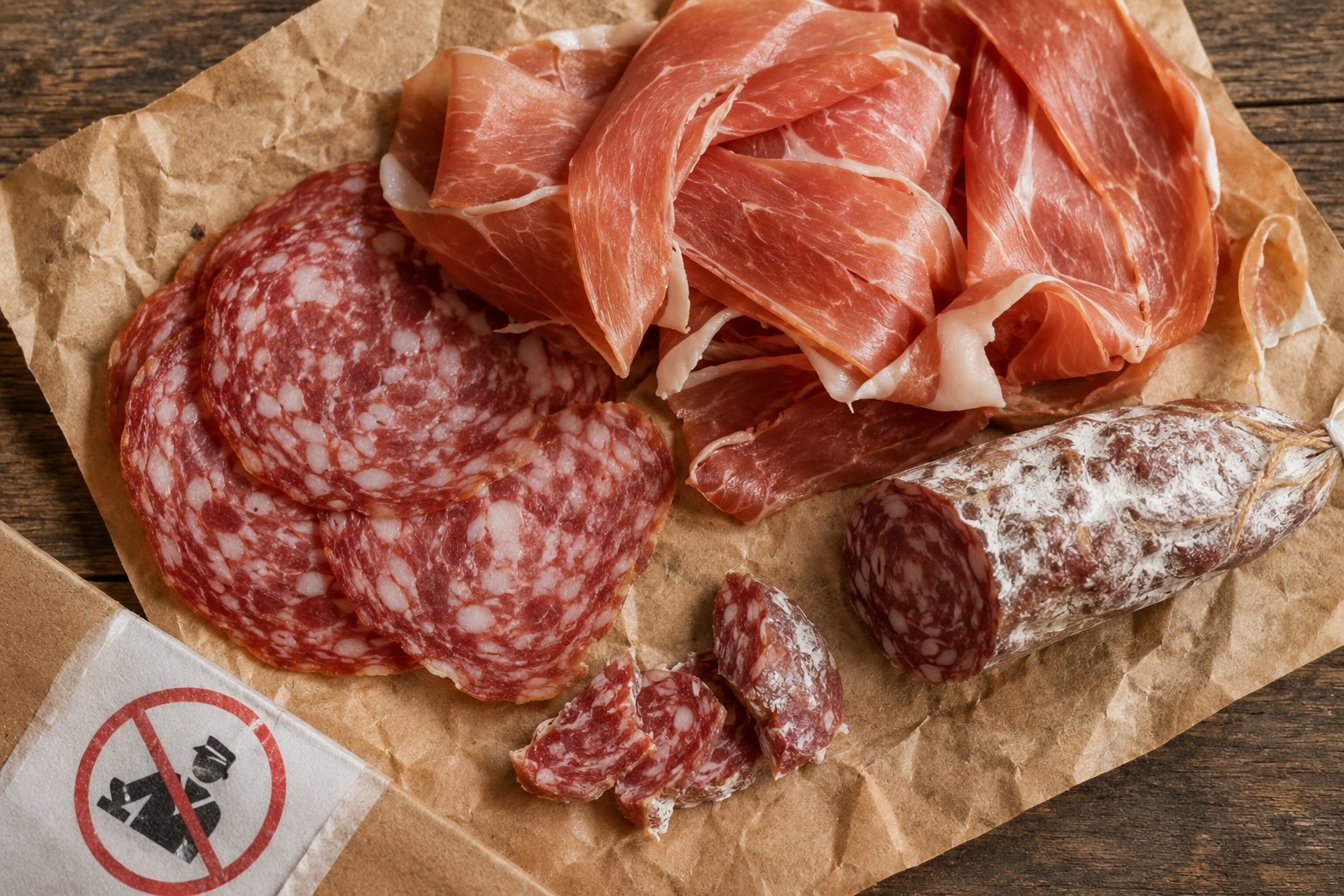
Cured and Fermented Meats: Prosciutto, Salami, and Sausages
This is where many travelers get a nasty surprise, especially those coming back from Italy, Spain, France, or Germany.
Cured hams, including prosciutto, Serrano ham, and Iberian ham, from France, Germany, Italy, and Spain may not be brought into the United States by travelers. This is a specific USDA prohibition that applies regardless of whether the product is commercially packaged, vacuum-sealed, or purchased at a premium shop. The prohibition exists due to the risk of foot-and-mouth disease in European pork production.
Salami from these same countries is also prohibited for travelers, even if commercially packaged.
This catches a lot of people off guard because these products are widely available in duty-free shops at European airports and are sometimes even marketed as travel-ready items. Buying it duty-free in Rome doesn’t mean it’s cleared for the US. It’s cleared of Italian VAT. US Customs rules are an entirely separate matter.
Cured meats from countries with disease-free status may be permitted with documentation, but verify the current status of the country before you pack anything.
Cheese: Better News Than You’d Expect
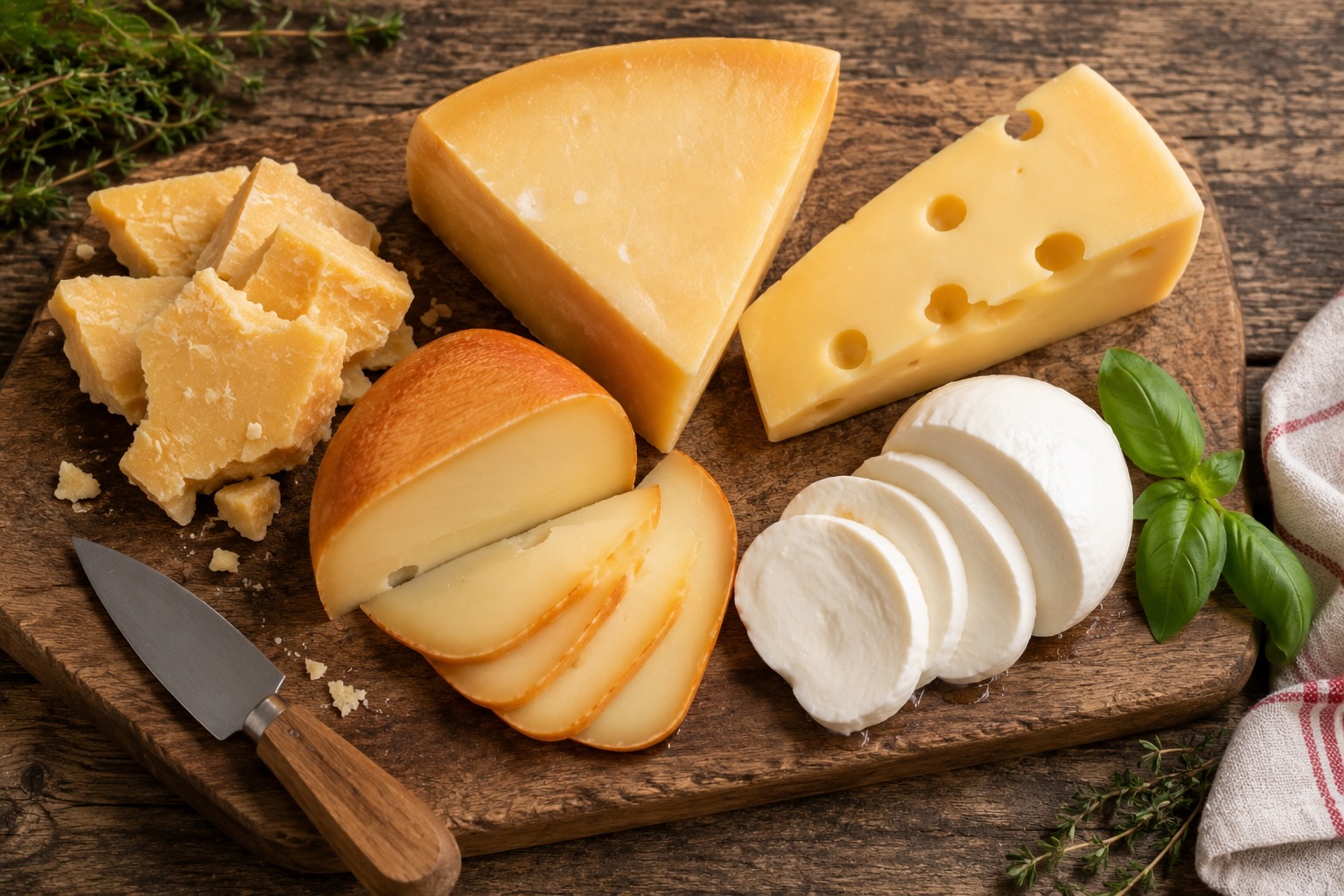
Cheese is where the question of which meats and cheeses you can bring into the US gets a much more welcome answer. The rules are more permissive than most travelers assume, with some important exceptions.
What’s generally allowed:
- Solid hard, and semi-soft cheeses — aged cheddar, Parmigiano-Reggiano, Manchego, Comté, Gruyère, Gouda, Pecorino, and similar firm cheeses are generally allowed from countries without foot-and-mouth disease
- Soft cheeses — Brie, Camembert, mozzarella, and similar soft (but not pourable) cheeses are also generally allowed
- Raw-milk cheeses — contrary to what many travelers believe, raw-milk cheeses are not automatically prohibited from entering the US. Even strong, aged raw-milk cheeses from Europe can generally come through
- The cheese does not need to be vacuum-sealed or shrink-wrapped to clear customs — packaging style is not a determining factor
What’s not allowed:
- Cheese that pours like a liquid — ricotta, cottage cheese, and similar liquid-consistency cheeses are not allowed
- Cheese containing meat products — if a cheese has meat inside or mixed in, it falls under meat restrictions
- Cheese from countries with active foot-and-mouth disease status — the country of origin matters for dairy just as it does for meat
- Unpasteurized soft cheeses that haven’t aged for at least 60 days may face additional scrutiny under FDA rules
The practical advice: bring your hard and semi-firm cheeses with confidence, declare them, keep the receipt or original label if possible, and be prepared for a quick inspection. Avoid cheese containing meat and anything that pours.
Other Dairy Products
The USDA’s rules for dairy beyond cheese follow a similar country-of-origin logic:
- Butter: generally allowed from countries without foot-and-mouth disease, commercially packaged
- Commercially packaged, shelf-stable milk products: allowed in unopened packages
- Liquid milk: restricted from most countries. An exception exists for liquid milk products for feeding infants and very young children in reasonable quantities
- Yogurt: commercially packaged, from disease-free countries, generally allowed
- Powdered milk: allowed, particularly in commercially packaged baking mixes
Seafood: The Most Permissive Category
Good news for travelers bringing back fish, shrimp, squid, or other seafood: the USDA does not regulate most seafood imports, and CBP is generally more permissive in this category than with meat or poultry. Fresh, frozen, cooked, smoked, dried, or canned seafood is typically allowed for personal use — declare it and present it for inspection.
Exceptions worth knowing:
- Caviar is limited to 125 grams per person — amounts above that will be confiscated
- Protected or endangered seafood species covered under CITES or US federal law are prohibited, regardless of quantity
- Breaded seafood products that contain animal-origin ingredients in the breading (milk, eggs) are regulated by the USDA and subject to inspection
Quick Reference Table
Here’s a quick summary of what meat and cheese you can bring into the US across the categories that travelers most commonly carry.
| Item | Generally allowed? | Key condition |
|---|---|---|
| Fresh/frozen meat (most countries) | No | Prohibited from countries with livestock disease status |
| Commercially canned/shelf-stable cooked meat | Usually yes | Must be sealed, labeled, commercially produced. Declare. |
| Homemade beef jerky | No | Prohibited regardless of origin or preparation |
| Commercial beef jerky (Canada, Australia) | Possible | From disease-free countries only. Not guaranteed. Declare. |
| Prosciutto / Serrano ham (Italy, Spain) | No | Specifically prohibited for travelers, even commercially packaged |
| Salami (France, Germany, Italy, Spain) | No | Prohibited for travelers from these specific countries |
| Hard/semi-soft cheese (Europe) | Yes | No meat, must not pour like liquid. Declare and present. |
| Soft cheese (Brie, mozzarella) | Generally yes | Fresh, frozen, smoked, dried, canned. Declare. Caviar limit: 125 g. |
| Ricotta / cottage cheese | No | Pours like liquid — not allowed |
| Fish, shrimp, seafood | Yes | Prohibited. Thoroughly cooked small amounts may pass at land borders at the inspector’s discretion. |
| Pork products (Mexico) | No | Prohibited. Thoroughly cooked small amounts may pass at land borders at inspector discretion. |
| Bushmeat (African wildlife) | No | Prohibited entirely regardless of preparation or packaging |
Practical Tips for Traveling With Meat and Dairy
Knowing what meat and cheese you can bring into the US is only half the battle. Here’s how to make sure what you’re carrying actually clears.
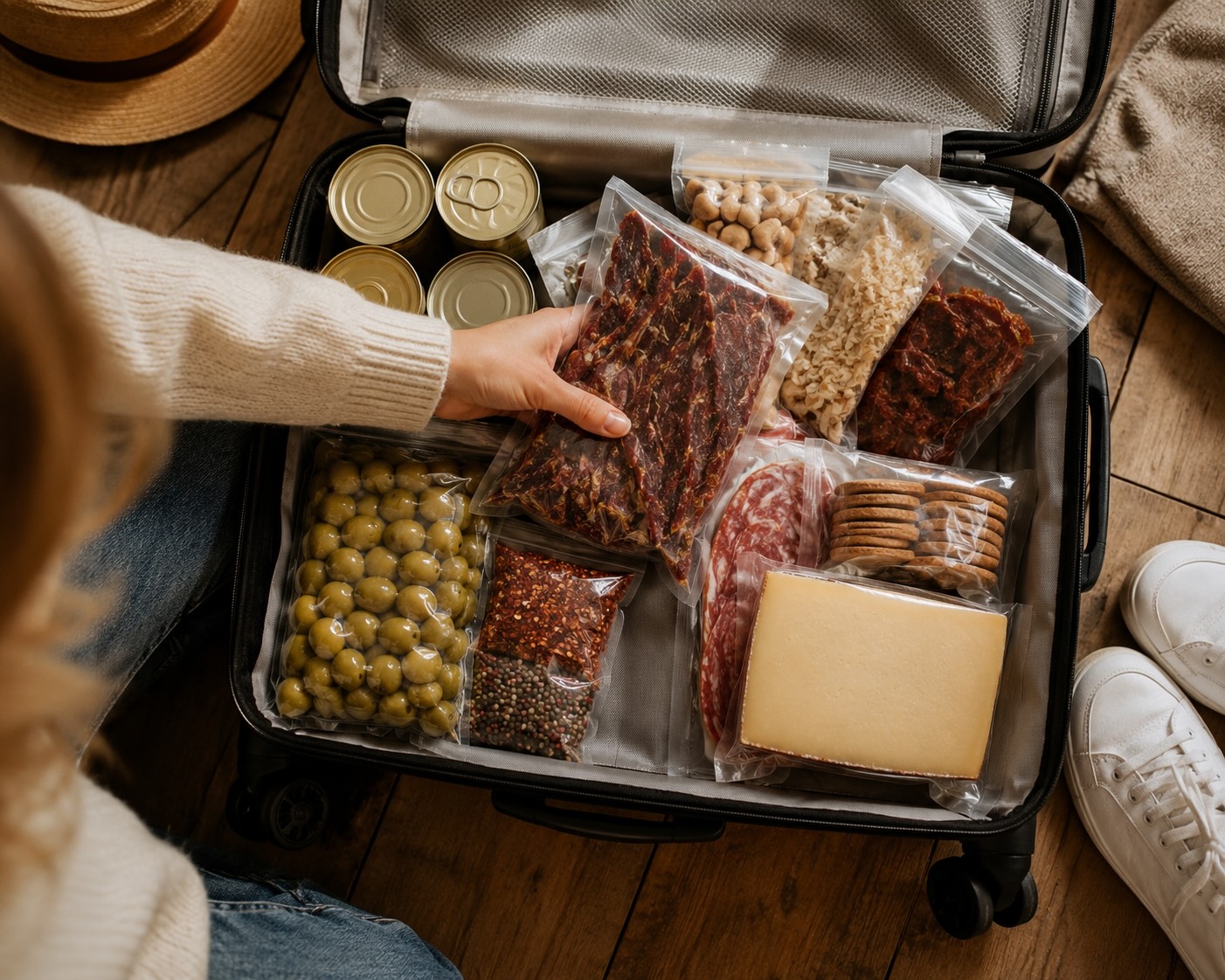
- Keep original packaging. The package label showing the country of origin, manufacturer, and ingredients is one of the accepted forms of documentation for animal products. Don’t remove it before you travel.
- Keep your receipt. A receipt from the shop counts as documentation of origin — particularly useful for cheese and specialty products.
- Check the country’s disease status before you pack. USDA disease statuses change. What was allowed last year from a specific country may not be allowed today. Use the USDA APHIS Veterinary Services Permitting Assistant at aphis.usda.gov to check the current status.
- Pack meat and dairy in checked baggage. It’s more practical for temperature-sensitive items, and it avoids TSA liquid restrictions that can affect soft cheeses packed with moisture.
- Don’t rely on the duty-free shop’s word. Airport duty-free staff are not US customs officers. A product being sold in an airport duty-free shop does not mean it’s cleared for US entry.
- Declare every item. Soup mixes, bouillon cubes, products with meat-based broth — if they contain meat or animal products as ingredients, they need to be declared. Many travelers are surprised to find that a packet of instant noodles with a meat-flavored broth packet falls under this rule.
Frequently Asked Questions
I bought prosciutto in a sealed, vacuum-packed package at a shop in Rome. Why can’t I bring it in?
The USDA prohibition on prosciutto, Serrano ham, and Iberian ham from certain European countries applies to travelers regardless of packaging. The restriction is based on the disease risk profile of pork production in those countries, not the packaging method. Commercial packaging doesn’t override the prohibition for travelers.
Can I bring canned corned beef from the Philippines or Nigeria?
Commercially canned, shelf-stable, fully cooked corned beef in sealed, labeled, and unopened packaging has a reasonable chance of clearing customs if it meets all the requirements — it must be commercially produced, properly labeled with the country of origin, and shelf-stable. Declare it and let the inspector make the determination. Keep the original can with its label intact.
What about dried fish or smoked fish?
Dried and smoked fish is generally allowed for personal use. Declare it and present it for inspection. Keep original packaging if possible. The 50-pound personal use limit applies here as well.
I’m traveling through Europe before coming back to the US. Can I pick up cheese and charcuterie along the way?
Cheese from most European countries — hard, semi-soft, and even many soft varieties — is generally fine as long as it doesn’t contain meat and isn’t liquid in consistency. Charcuterie (cured meats, salami, prosciutto) from France, Germany, Italy, and Spain is prohibited for travelers. Cheese, yes, cured meats no, is the practical rule for European travel.
Does the rule apply to products I’m carrying as gifts for someone else?
Yes. Whether you bought it for yourself or as a gift, the same customs rules apply. The intention behind the item doesn’t affect its admissibility.
Planning Your Next International Trip?
ASAP Tickets finds the best international fares for international travel. Let us handle the flight while you focus on your trip. To book, call us 24/7: 1-844-300-7983. Or visit asaptickets.com/flights to search for flights.
More from our international travel rules series:
- Your $800 Duty-Free Allowance: How to Shop Smart Abroad — Know your limits before you shop
- The $10,000 Cash Rule: What Travelers Get Wrong About Carrying Cash — What you actually need to declare at the border
- What Food Can You Bring Into the US? — Can you bring mangoes, coffee, or candy from your international trip?
Please note
This article is for informational purposes only and reflects USDA and CBP regulations as of April 2026. Meat and dairy import rules change frequently in response to disease outbreaks and updates to countries’ status. Always verify current requirements at aphis.usda.gov or cbp.gov before you travel. For more travel tips, visit the ASAP Tickets blog.

Get it right to your inbox by subscribing to ASAP Tickets weekly emails featuring the hottest flight deals from US to the .
Massive savings • Unsubscribe at any time.
You were sucessfully subscribed
Please check your inbox to confirm the subscription