

Quick Answer: How Many Airports Does Italy Have?
Italy has 44 airports with commercial passenger service, according to ENAC, Italy’s civil aviation authority, and the two largest are Rome Fiumicino (FCO) and Milan Malpensa (MXP). Fiumicino handled about 50.9 million passengers in 2025 and Malpensa about 31 million, so most international visitors to Italy land at one of the two. Updated October 2026.
Here’s the part most lists skip: the biggest airport isn’t always the best one for your trip. The right airport is the one closest to where you’re actually headed, and this guide helps you pick it.
A quick note on numbers: you’ll see Italy’s airport count given as 10, 25, 41, or more online, because sites define “airport” differently. We use ENAC’s count of airports open to commercial traffic. If you count every military base and private airstrip, Italy has well over 100.
Map of Airports in Italy
Italy’s main airports run from Milan in the north to Sicily in the south, with Rome in the middle and two big islands, Sicily and Sardinia, each served by their own airports.
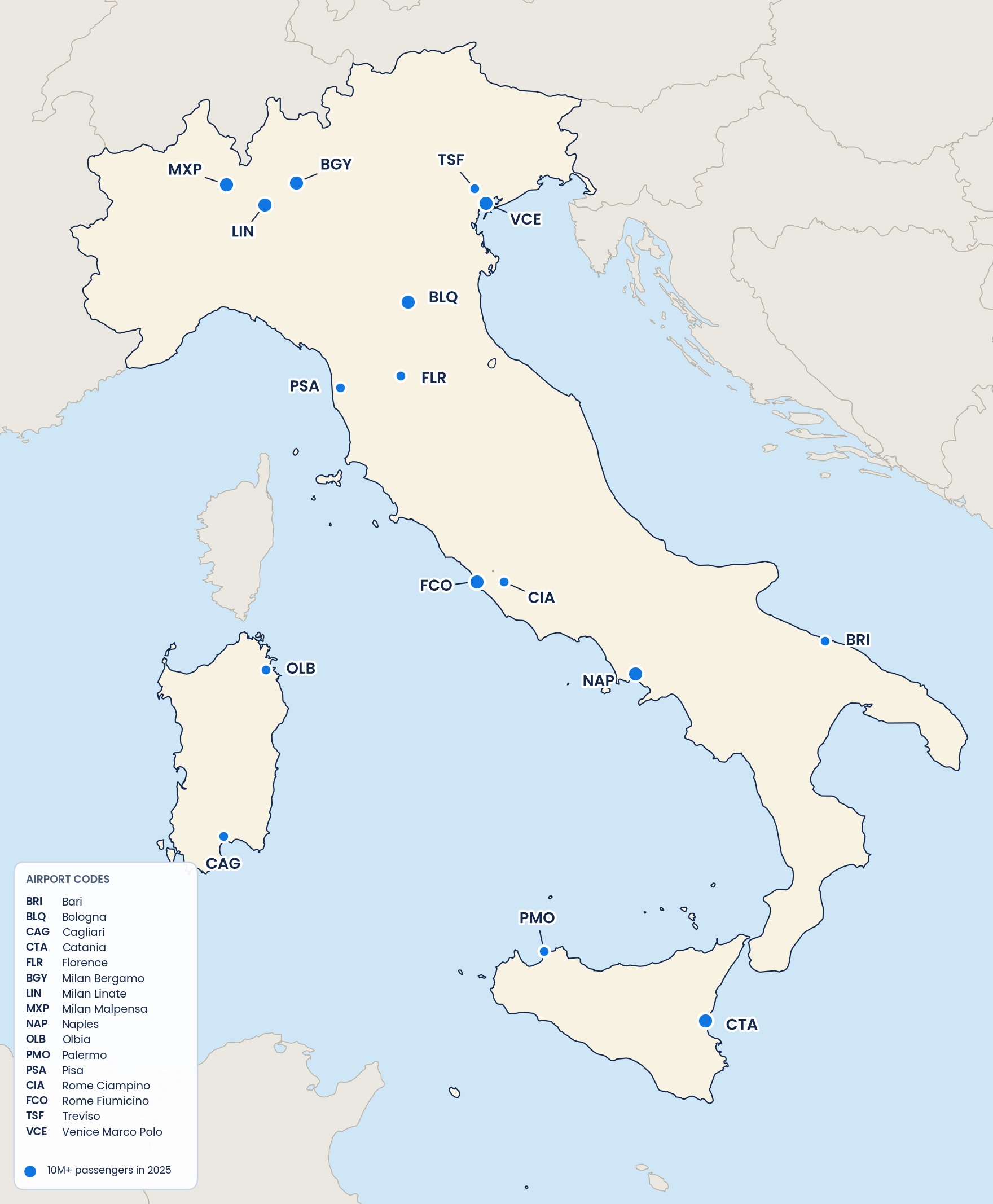
- North: Milan Malpensa (MXP), Milan Linate (LIN), Milan Bergamo (BGY), Venice (VCE), Treviso (TSF), Bologna (BLQ)
- Central: Rome Fiumicino (FCO), Rome Ciampino (CIA), Florence (FLR), Pisa (PSA)
- South: Naples (NAP), Bari (BRI)
- Islands: Catania (CTA), Palermo (PMO), Cagliari (CAG), Olbia (OLB)
Major International Airports in Italy
Italy’s main international airports are Rome Fiumicino (FCO), Milan Malpensa (MXP), Venice Marco Polo (VCE), Naples (NAP), and Catania (CTA), and the 16 airports below cover almost every trip travelers plan.
| Airport | Code | City | Best for | US nonstops |
|---|---|---|---|---|
| Rome Fiumicino | FCO | Rome | Italy’s biggest gateway; Rome, central and southern Italy | Yes, year-round |
| Rome Ciampino | CIA | Rome | Budget flights within Europe | No |
| Milan Malpensa | MXP | Milan | Northern Italy’s main long-haul gateway; Lake Como, Lake Maggiore | Yes, year-round |
| Milan Linate | LIN | Milan | Short hops to and from Europe and Italian cities, close to the city | No |
| Milan Bergamo | BGY | Bergamo (serves Milan) | Budget flights within Europe | No |
| Venice Marco Polo | VCE | Venice | Venice, the Veneto, gateway to the Dolomites | Yes, mostly seasonal |
| Treviso | TSF | Treviso (serves Venice) | Budget flights within Europe | No |
| Florence | FLR | Florence | Florence and Tuscany, short European hops | No |
| Pisa | PSA | Pisa | Tuscany, Cinque Terre | No |
| Bologna | BLQ | Bologna | Emilia-Romagna, food trips, Italy road trips | No |
| Naples | NAP | Naples | Amalfi Coast, Capri, Pompeii | Yes, seasonal |
| Bari | BRI | Bari | Puglia (Apulia) | Yes, seasonal |
| Catania | CTA | Catania | Eastern Sicily, Mount Etna, Taormina | Yes, seasonal |
| Palermo | PMO | Palermo | Western Sicily | Yes, seasonal |
| Cagliari | CAG | Cagliari | Southern Sardinia | No |
| Olbia | OLB | Olbia | Costa Smeralda, northern Sardinia | Yes, seasonal |
“Seasonal” means the nonstop typically runs from late spring to early fall and pauses in winter. Schedules change, so confirm dates with the airline or one of our agents before you plan around a nonstop.
Biggest and Busiest Airports in Italy

The busiest airport in Italy is Rome Fiumicino, which handled about 50.9 million passengers in the 2025 calendar year, the first time it has passed 50 million in a single year, followed by Milan Malpensa at about 31 million for the same year. Here are the biggest airports in Italy by total passengers in the 2025 calendar year (arrivals and departures combined):
- Rome Fiumicino (FCO): about 50.9 million passengers
- Milan Malpensa (MXP): about 31 million
- Milan Bergamo (BGY): about 16.9 million
- Naples (NAP): about 13.3 million
- Catania (CTA): about 12.4 million
- Venice Marco Polo (VCE): about 11.9 million
- Bologna (BLQ): about 11.1 million
- Milan Linate (LIN): about 11.1 million
Each of these eight airports handled more than 10 million passengers on its own in 2025, and Fiumicino and Malpensa are far above that line. Together, Italy’s airports welcomed roughly 230 million travelers that year. Passenger counts are rounded and come from Italy’s civil aviation authority (ENAC), the airport association Assaeroporti, and the airports themselves.
Best Airport to Fly Into Italy, By Destination
The best airport to fly into depends on where you’re headed: Naples for the Amalfi Coast, Florence or Pisa for Tuscany, Milan Malpensa for Lake Como, Pisa for Cinque Terre, Venice for the Dolomites, Catania or Palermo for Sicily, and Olbia or Cagliari for Sardinia.
| Destination | Fly into | Typical transfer |
|---|---|---|
| Amalfi Coast (Positano, Amalfi, Ravello) | Naples (NAP) | About 1.5 to 2 hours by car; add 30 to 60 minutes in July and August |
| Tuscany (Florence, Siena, Chianti) | Florence (FLR) or Pisa (PSA) | Florence airport to central Florence: about 20 to 25 minutes by tram. Pisa airport to Florence: about 1.5 hours by train |
| Lake Como | Milan Malpensa (MXP) | About 1 hour by car, or 1.5 hours by train |
| Cinque Terre | Pisa (PSA) | About 1.5 to 2 hours by train via Pisa Centrale and La Spezia |
| The Dolomites (Cortina d’Ampezzo) | Venice Marco Polo (VCE) | About 2 hours by car or direct bus |
| Sicily, east (Taormina, Mount Etna) | Catania (CTA) | Catania airport to Taormina: about 1 hour by car |
| Sicily, west (Palermo and the north coast) | Palermo (PMO) | Palermo airport to the city centre: about 40 minutes by car |
| Sardinia, Costa Smeralda | Olbia (OLB) | Olbia airport to Porto Cervo: about 30 to 45 minutes by car |
| Sardinia, south | Cagliari (CAG) | Cagliari airport to the city centre: about 15 minutes by car or taxi |
Transfer times are typical by car or the fastest common public option, outside rush hour and peak-season traffic, so give yourself a cushion on the day you fly. A few extra notes:
- The Dolomites: if you’re heading to Val Gardena or the western Dolomites, Verona, Bolzano or Innsbruck in Austria can be closer than Venice.
- Amalfi Coast: there’s no direct train or bus from Naples airport to the coast. Most people take a private transfer, or a bus to Sorrento and then onward.
- Cinque Terre: the villages have no airport of their own, so most travelers fly into Pisa and take the train.
US and Canada Nonstops to Italy
Rome and Milan have the most dependable US nonstops, while Venice, Naples, Sicily, Bari and Olbia are mainly summer-season routes, so it pays to check dates before you build a trip around one.
From the US
- Rome (FCO): the widest choice, with service from New York and other US hubs on Delta, United, American and ITA Airways.
- Milan (MXP): nonstops with Delta, United and American, including American’s Miami service, which started in 2026.
- Venice (VCE) and Naples (NAP): mostly summer nonstops from New York and other hubs, with Delta, United and American all in the mix.
- Sicily: Delta flies New York (JFK) to Catania, and United flies Newark to Palermo, both as seasonal routes.
- Bari (BRI) and Olbia (OLB): new for summer 2026, with United from Newark to Bari and Delta from JFK to Olbia in Sardinia.
From Canada
Most Canada nonstops land in Rome and Venice. Air Transat flies Toronto and Montreal to both, mainly from spring through October, and also links Toronto with Lamezia Terme in Calabria. Air Canada and WestJet also serve Rome nonstop from Canadian cities. Where there’s no nonstop, a single connection through a major hub is usually an easy fix.
Airlines add and drop routes every season, so treat this as a guide rather than a schedule. For airlines, routes, and the best time to book, see our Italy flights guide, or call our agents any time, day or night 📞
Rome vs Milan vs Venice: How to Choose For a Multi-City Trip
If you’re visiting more than one Italian city, an open-jaw ticket (flying into one city and home from another) often saves you a day of backtracking compared with a round trip to the same airport.
Italy’s high-speed trains make it easy. Typical Frecciarossa and Italo journey times are about 1.5 hours from Rome to Florence, 2 hours from Florence to Venice, 2.5 hours from Milan to Venice, and around 3 hours from Rome to Milan.
A few popular ways to combine the big three:
- Fly into Rome, home from Venice: history first, canals last, with Florence as an easy stop in between. Rome has the widest choice of US nonstops, which is why it’s the classic starting point. Our Rome flights guide has the details.
- Fly into Venice, home from Rome: the same trip in reverse. Handy if your dates fit a Venice nonstop, since many of those run in summer.
- Fly into Milan, home from Rome: a good fit if you’re adding Lake Como or northern Italy first, with about 3 hours on the train between the two.
- Fly into Naples, home from Rome: ideal for the Amalfi Coast, then a trip of just over an hour by train to Rome.
The best route depends on your dates, the airlines flying that week, and how much time you want on the ground in each city. Open-jaw fares aren’t always cheaper than a round trip, and sometimes they are, so it’s worth pricing both. That’s something our agents do all day, and you can read more in our guide to flights to Italy from the USA.
Ready to Book Your Flight to Italy?
Picking the right airport is exactly the kind of puzzle our travel agents love. Whether you’re mapping an open-jaw trip from Rome to Venice or working out the smartest way to reach the Amalfi Coast, a real person can compare your options with you, 24/7 by phone.
Explore Italy flights with ASAP Tickets or call our agents at +1 844-300-7983 today and tell us where you’re headed in Italy.
Airports in Italy: Frequently Asked Questions
How many airports does Italy have?
Italy has 44 airports open to commercial passenger traffic, according to ENAC. Counting military bases and small private airfields, the total is well over 100.
How many airports in Italy are international?
There’s no single official count, because nearly every commercial airport with scheduled flights abroad works as an international airport in practice. International passengers made up about 68% of Italy’s airport traffic in 2025. Only a handful of airports have nonstops from North America, led by Rome Fiumicino and Milan Malpensa.
What is the biggest airport in Italy?
Rome Fiumicino (FCO) is the biggest and busiest airport in Italy, with about 50.9 million passengers in 2025. Milan Malpensa (MXP) is second, with about 31 million.
Which airport is best for the Amalfi Coast, Tuscany, or Lake Como?
Fly into Naples (NAP) for the Amalfi Coast, Florence (FLR) or Pisa (PSA) for Tuscany, and Milan Malpensa (MXP) for Lake Como. See the destination table above for typical transfer times.
Is there more than one airport in Rome and Milan?
Yes. Rome has Fiumicino (FCO) and Ciampino (CIA), and Milan has Malpensa (MXP), Linate (LIN) and Bergamo (BGY). Fiumicino and Malpensa handle the long-haul flights, while Ciampino and Bergamo mostly serve budget carriers within Europe.

Get it right to your inbox by subscribing to ASAP Tickets weekly emails featuring the hottest flight deals from US to the .
Massive savings • Unsubscribe at any time.
You were sucessfully subscribed
Please check your inbox to confirm the subscription